.png)
How VISA VAMP Is Rewriting the Rules on Ecommerce Payments Risk

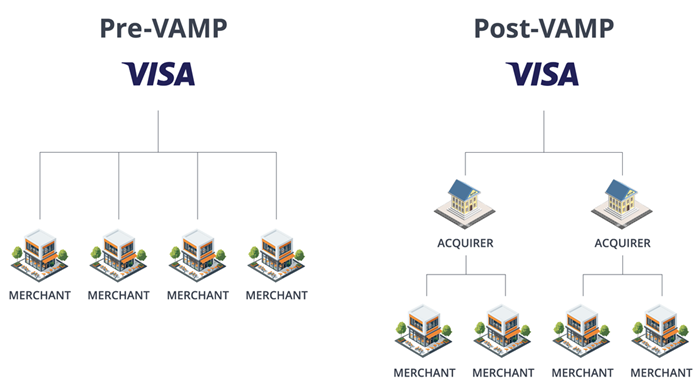
For years, ecommerce merchants optimized for one number: chargeback rate.
Keep it below monitoring thresholds. Use tools like RDR, CDRN, and Ethoca Alerts to intercept disputes early. Refund fast. Stay safe.
That strategy still matters. But Visa changed the scoreboard.
VAMP expands what “risk” means — and if you’re only managing chargebacks, you’re now managing only part of the equation.
In plain English
You can have a clean chargeback rate and still look risky under VAMP.
Because VAMP includes fraud reports (TC40), not just disputes.
What Is VAMP?
VAMP stands for Visa Acquirer Monitoring Program.
Under the updated framework, Visa evaluates merchant risk using:
- Chargebacks
- TC40 fraud reports
This is the key shift. Chargebacks are still tracked. Fraud reporting now directly affects your monitoring profile.
What Is a TC40?
A TC40 is generated when a cardholder contacts their bank and says they did not authorize a transaction.
The issuer flags it as fraud and sends a fraud report to Visa.
Important:
- No dispute is required
- No chargeback is required
- You often don’t see it in real time
- It still counts toward monitoring
How VAMP Is Calculated
VAMP = (Chargebacks + TC40) / Total Transactions
It’s not a new name for chargebacks. It’s a combined fraud + dispute signal.
Do RDR, CDRN and Ethoca Still Help?
Yes.
They reduce chargebacks by resolving disputes early.
They protect your chargeback rate and reduce operational cost.
But here’s the nuance:
Alerts reduce chargebacks.
They do not reliably remove a TC40 once fraud has already been reported to the bank.
You can have a clean chargeback rate and still see pressure under VAMP if fraud reports are high.
Who Is Most Exposed?
Subscription and trial-based merchants.
When customers don’t recognize a rebill, they often skip support and go straight to their bank. That creates a TC40 — even if no chargeback follows.
Common drivers of high fraud reports:
- Unclear billing descriptors
- Weak post-purchase communication
- Trial-to-rebill shock
- Hard-to-find cancellation flows
- Low-quality traffic
What Merchants Should Do Now
- Keep running chargeback prevention.
- Get visibility into TC40 volume.
- Reduce fraud signals at the source.
- Treat fraud reporting as a core metric, not a side metric.
The metric changed.
If your strategy hasn’t changed with it, you’re exposed.